Introducing IPAB-AT-2026.01: The First PV AI Baseline for Article Triage
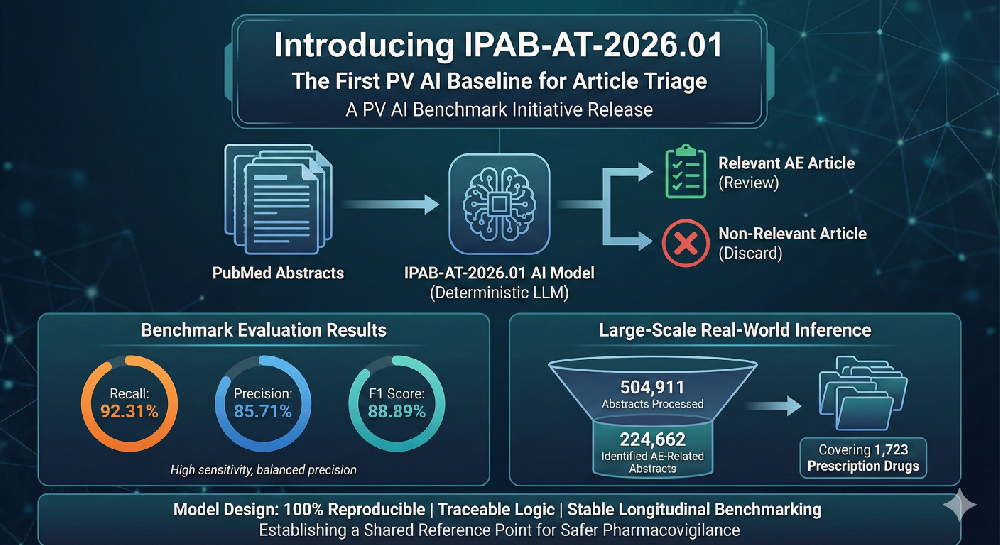
As part of the PV AI Benchmark Initiative, we’re releasing our first benchmark baseline:
Insilicom PV AI Baseline – Article Triage – 2026.01 (IPAB-AT-2026.01).
Article triage is the entry point of literature monitoring in pharmacovigilance. Every downstream step, adverse event extraction, MedDRA mapping, and case processing, depends on whether relevant articles are identified in the first place.
IPAB-AT-2026.01 evaluates a focused but foundational question:
Can an AI model reliably determine whether a PubMed abstract contains an adverse event or indicates that the full text may contain one?
Benchmark Evaluation Results
On a manually labeled benchmark dataset reflecting real-world literature monitoring challenges, IPAB-AT-2026.01 achieved:
Recall: 0.9231
Precision: 0.8571
F1 score: 0.8889
This performance profile prioritizes high sensitivity while maintaining balanced precision, a critical requirement in pharmacovigilance, where missed adverse events carry regulatory risk.
Large-Scale Real-World Inference
Beyond the benchmark dataset, we applied the model across the full scope of PubMed abstracts related to prescription drugs:
504,911 abstracts processed
Covering 1,723 prescription drugs
224,662 abstracts identified as containing or potentially containing adverse events
1,633 drugs associated with at least one AE-related publication
This large-scale inference reflects operational reality rather than isolated benchmark performance.
Model Design and Reproducibility
IPAB-AT-2026.01 is built on a fine-tuned large language model configured as a deterministic classification model, ensuring 100% reproducibility.
In regulated domains like pharmacovigilance, reproducibility is not optional.
Generative models, while powerful, are inherently probabilistic and may produce non-deterministic outputs. For benchmark evaluation and regulatory alignment, deterministic behavior is essential.
A fully reproducible model enables:
• Traceable decision logic
• Stable longitudinal benchmarking
• Reduced variability in human-in-the-loop workflows
• The possibility of minimizing manual review, if human-level or above-human performance can be demonstrated consistently
A Shared Reference Point
IPAB-AT-2026.01 is:
• Task-specific (article triage as a defined PV workflow step)
• Versioned (2026.01 for longitudinal comparison)
• Transparent (clearly defined datasets and evaluation protocol)
• Scalable (validated at real-world scale)
Full benchmark results and large-scale outputs are available on our website and will be deposited in a credible third-party repository.
This release does not represent an endpoint.
It establishes a reference baseline the field can use to evaluate systems, compare approaches, and systematically improve AI in pharmacovigilance.
Better evaluation leads to better models.
Better models lead to safer pharmacovigilance.
More benchmark tasks will follow.