The scientific paper may not be the final research artifact.
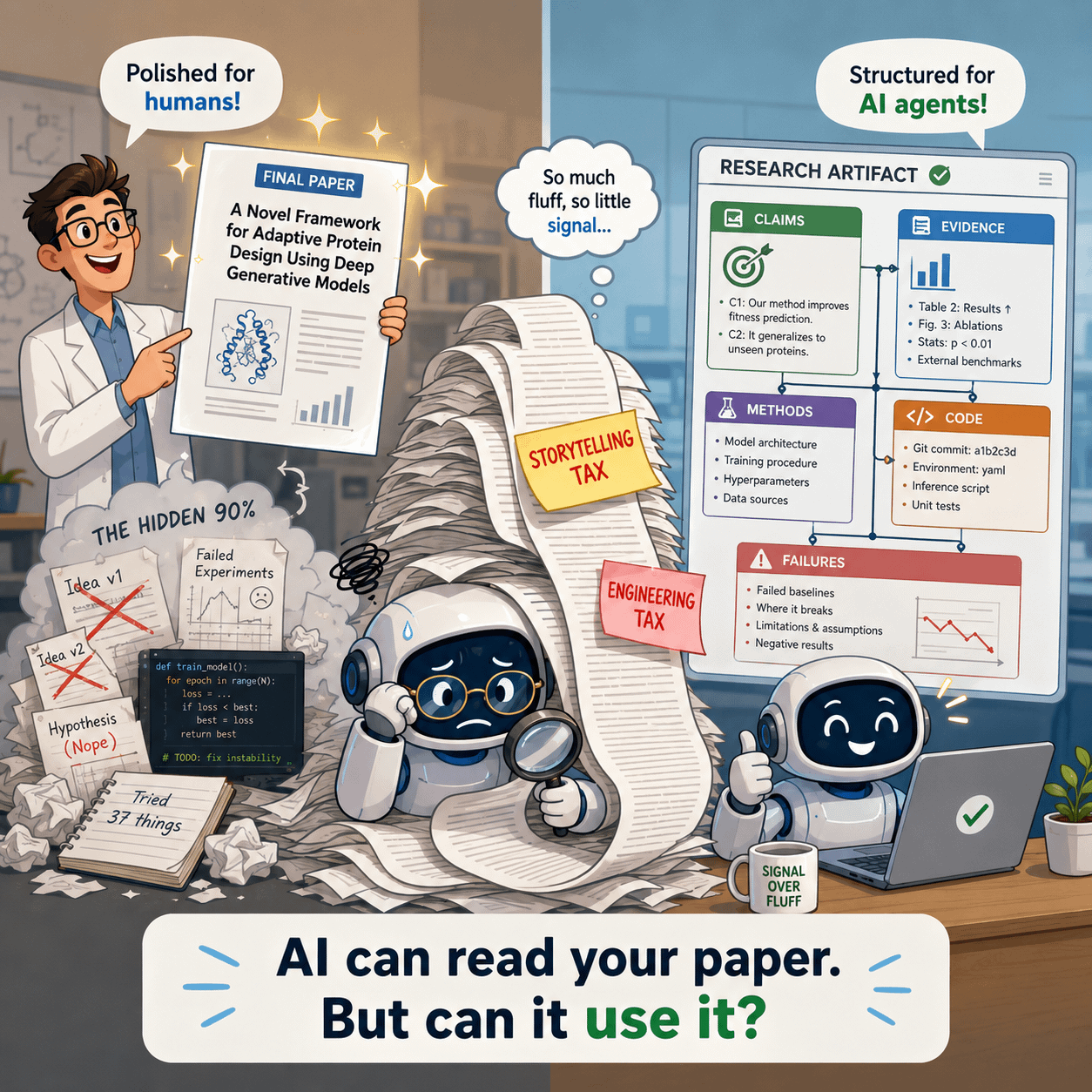
A new paper, “The Last Human-Written Paper: Agent-Native Research Artifacts,” makes a provocative argument:
Scientific papers were designed for human readers.
But the next major readers of science may be AI agents.
And AI agents need something very different.
A paper compresses months or years of research into a clean linear story. That is useful for humans, but it removes a lot of important information:
Failed experiments
Rejected hypotheses
Implementation tricks
Hyperparameter choices
Why one direction was abandoned
What actually happened during the research process
The authors call this the “Storytelling Tax” and the “Engineering Tax.”
I like this framing.
In science, the final result is important. But the path toward that result is also knowledge.
For AI co-scientists, that path may become even more valuable.
If an AI agent wants to reproduce or extend a study, it should not only read the polished conclusion. It needs access to the structured logic, executable code, evidence, and exploration history.
That is what the authors propose with Agent-Native Research Artifacts, or ARA.
The idea is simple but powerful:
Instead of treating the paper as the primary research object, treat it as one view of a richer, machine-actionable research package.
This resonates strongly with what we are building in biomedical AI.
Drug discovery does not need more PDFs alone.
It needs structured, traceable, executable knowledge.
Claims should connect to evidence.
Evidence should connect to methods.
Methods should connect to assumptions.
Failures should not disappear.
Because in noisy fields like biology, knowing what did not work can be just as important as knowing what did.
Maybe the future of scientific publishing is not “AI writes papers.”
Maybe it is “humans and AI build research artifacts that papers can be generated from.”
That would be a much more meaningful shift.
What do you think: should failed experiments and research trajectories become first-class scientific outputs?