Rethinking Drug Target Identification in the AI Era
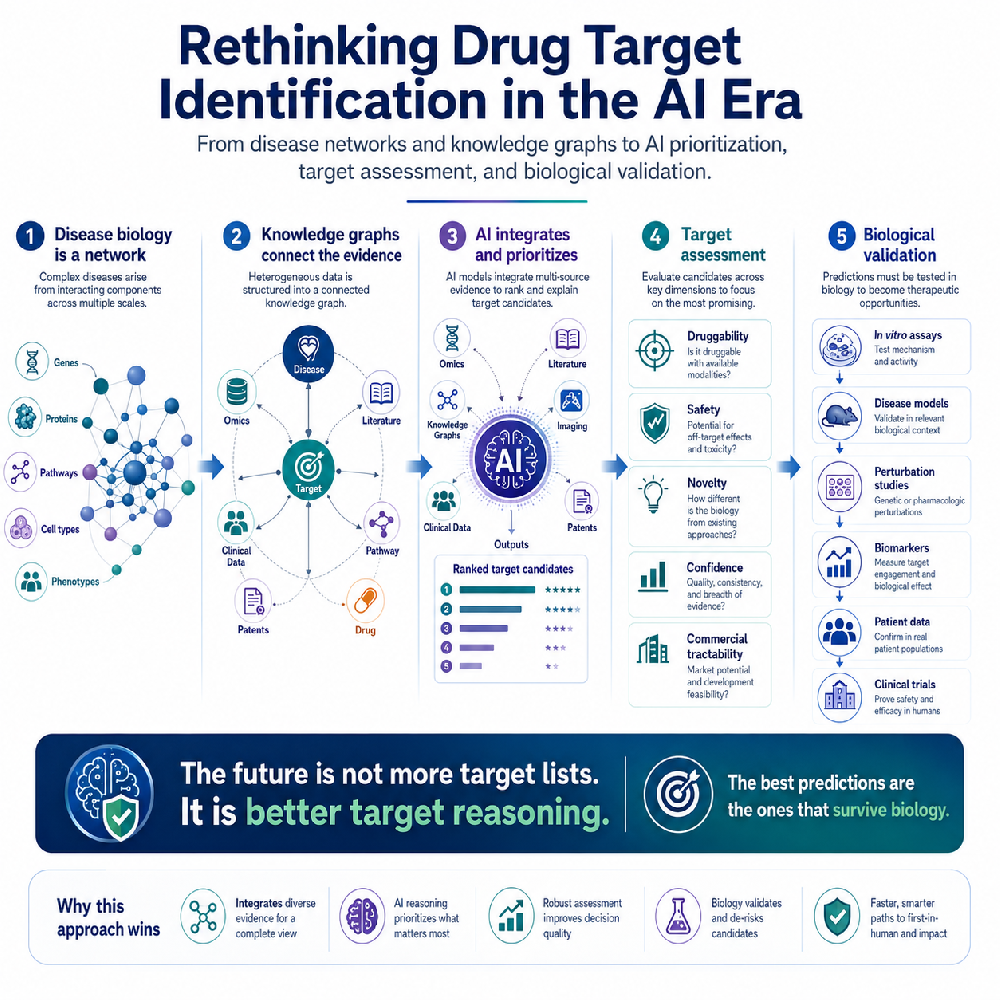
Rethinking Drug Target Identification in the AI Era
Drug discovery does not usually fail because we lack ideas. It often fails because too many ideas are built on weak biological understanding. This is especially true in drug target identification, where a promising-looking gene or protein can easily become the starting point for years of investment, even when the underlying biology is not strong enough to support that investment.
A drug target is not simply a gene or protein that appears to be associated with a disease. A target is a therapeutic hypothesis. It asks whether modulating a specific biological molecule, in a specific direction, within a specific disease context and patient population, can produce meaningful benefit with acceptable safety. That is a much harder question than asking whether a gene is differentially expressed, genetically associated with a disease, or frequently mentioned in the literature.
This is why target identification remains one of the most important steps in drug discovery. Better chemistry matters. Better screening matters. Better protein structure prediction matters. Better clinical trial design matters. But if the target biology is wrong, the rest of the pipeline is built on a fragile foundation. A beautiful molecule against the wrong target is still unlikely to become a useful medicine.
The central challenge is that disease biology is rarely driven by one isolated gene. Most diseases emerge from networks of genes, proteins, pathways, cell types, tissues, environmental factors, and patient-specific contexts. A target that looks promising in isolation may look very different when placed inside the biological system. This is where network biology, knowledge graphs, and AI are beginning to reshape how we think about target discovery.
From Isolated Targets to Disease Networks
For a long time, drug discovery has often been framed around a simple model: one disease, one target, one drug. This model is useful for communication, but it is often too simple for real biology.
Diseases are relational. Genes interact with other genes. Proteins form complexes and signaling cascades. Pathways cross-talk. Cell types behave differently across tissues, disease stages, and patient subgroups. Drugs affect not only their intended targets, but also related pathways and off-target mechanisms. A target should therefore be evaluated not only as an isolated entity, but as part of a disease network.
When we place a target inside a network, better questions become possible. Is the target close to the disease module? Does it regulate the right biological process? Is it upstream or downstream of disease activity? Is it connected to essential functions that may create safety risks? Does it help explain patient phenotypes? Is it likely to be causal, or merely correlated with disease activity?
This shift matters because association alone is not enough. A gene may be associated with a disease because it is a driver, a compensatory response, a downstream marker, or simply a passenger in a larger biological process. Network-based methods help us examine a target in context by connecting genetic evidence, protein interactions, pathways, drug-target relationships, disease associations, omics data, and clinical knowledge.
This does not make target discovery easy. Networks can be incomplete. They can be biased toward well-studied genes. They can miss tissue-specific or cell-type-specific biology. They still require rigorous benchmarking and validation. But networks provide a more realistic representation of disease than a flat list of candidate genes.
Biology is relational. Disease is relational. Drug discovery should be relational too.
Knowledge Graphs as Infrastructure
The next step beyond networks is the knowledge graph.
One of the biggest problems in target discovery is not the lack of data. It is that the data are scattered. Genetics lives in one place. Protein interactions live in another. Pathways, literature, clinical evidence, drug-target data, phenotypes, patents, and omics datasets are often stored in different systems, described with different vocabularies, and analyzed under different assumptions.
A knowledge graph provides a structured way to connect these pieces. In a biomedical knowledge graph, genes, proteins, diseases, drugs, pathways, phenotypes, publications, clinical trials, tissues, cell types, and adverse events can be represented as entities. Their relationships can be represented explicitly: a gene is associated with a disease, a drug inhibits a target, a protein participates in a pathway, a variant affects expression, a target is expressed in a tissue, or a publication supports a claim.
This is not just a database design choice. It changes what target discovery can become. A traditional search system helps us find documents. A knowledge graph helps us connect the science inside those documents.
For target discovery, that means we can move from asking, “Which papers mention this gene and disease?” to asking, “What is the evidence chain connecting this target to this disease, through which mechanisms, in which biological context, and with what level of uncertainty?”
This is why I see knowledge graphs as infrastructure, not just tools. They can support systematic evidence integration. They can make hidden relationships searchable. They can provide structured context for AI models. They can help scientists move from disease to targets, from targets to drugs, from drugs to adverse events, and from all of these back to the underlying evidence.
This is especially important for AI. Bigger models alone are not enough. AI systems need high-quality, structured, evidence-linked knowledge to reason over. Without that infrastructure, AI may simply learn patterns from fragmented, biased, and incomplete data. Better AI for drug discovery starts with better knowledge infrastructure.
From Search to Prioritization
Target discovery has often been treated as a search problem. Search the literature. Search omics datasets. Search genetic associations. Search pathway databases. Search drug-target databases. But today, the harder problem is prioritization.
Modern biomedical research can generate many candidate targets for almost any disease. The challenge is deciding which ones deserve years of investment. A strong target hypothesis needs many layers of evidence. Genetic evidence can suggest causality. Transcriptomics and proteomics can show whether a target is dysregulated in the right disease context. Pathways and networks can show where the target sits in the biological system. Cellular imaging can reveal whether perturbing the target changes disease-relevant phenotypes. Clinical and phenotypic data can show whether the mechanism is relevant to real patients. Literature can capture what is already known, what is contradictory, and what remains uncertain. Patents, regulatory data, and industry reports can inform novelty, competition, and commercial tractability.
No human team can manually integrate all of this evidence at scale. AI can help organize these scattered signals into a more systematic assessment process. But the goal should not be to generate longer target lists. We already have enough lists. The goal should be better evidence maps.
A useful AI system for target discovery should help answer why this target, why this disease, why this patient population, and why this mechanism. It should show what evidence supports the hypothesis, what evidence contradicts it, and what evidence is missing. This is the shift from target search to target reasoning. It is also where knowledge graphs, foundation models, graph neural networks, imaging models, and literature mining can become complementary rather than competing technologies.
Target Assessment May Be More Important Than Target Identification
Finding a target is exciting. But finding a target is not the same as knowing whether it is worth pursuing. That second question may be even more important.
A target can look biologically interesting and still fail for many reasons. It may not be druggable. It may carry unacceptable safety risks. It may have weak causal evidence. It may be too crowded competitively. It may be novel but low confidence. Or it may be high confidence but offer little room for differentiation. This is why target assessment deserves as much attention as target identification.
A good target is not simply a gene associated with disease. A good target needs a strong therapeutic hypothesis and a feasible development path. Several questions matter. Can we modulate the target with an appropriate therapeutic modality? Can we modulate it safely? Is the target’s role in disease causal or merely correlative? Is there human genetic, clinical, or phenotypic evidence? Is the biology relevant to the patient population we want to treat? Is there a biomarker strategy? Is the competitive landscape favorable? Is there a path to experimental and clinical validation?
This is where AI can be useful, but not by giving a magical score. A single score can hide uncertainty and create false confidence. The real value of AI is to integrate evidence layers, expose gaps, compare candidates consistently, and help teams make better decisions.
In this sense, target discovery becomes target decision-making. The future of AI in drug discovery should not be judged by how many targets it can generate. It should be judged by whether it helps scientists decide which targets deserve serious investment. The most expensive target is not always the one we miss. It may be the one we pursue for too long without enough evidence.
AI Still Needs Biological Validation
AI can help us find better drug targets. But AI does not make a target true.
A model can integrate omics data, literature, knowledge graphs, imaging, clinical evidence, patents, and industry data. It can rank targets, explain connections, and generate hypotheses faster than any human team. But in drug discovery, a prediction is still only a prediction.
There are several reasons we need to be careful. First, biological data are biased. Well-studied genes appear in more papers, more databases, and more networks. That can make them look more important than they really are. A model trained on biased knowledge may reproduce the popularity of a target rather than its biological importance.
Second, biology is context-specific. A target may matter in one tissue, one cell type, one disease stage, or one patient subgroup, but not in another. A broad disease association may fail when tested in the specific context that matters for therapy.
Third, benchmarking remains difficult. It is not enough to show that a model can recover known targets. Known targets are often biased toward well-studied biology. We need rigorous benchmarks that test whether methods can identify useful new targets, not just rediscover the past.
Fourth, explainability matters. In drug discovery, “the model said so” is not enough. Scientists need to know what evidence supports a target, what assumptions were made, what uncertainty remains, and what experiments should be done next.
Finally, every target hypothesis must face biology. In vitro assays, disease models, perturbation studies, biomarkers, patient data, and clinical trials are where computational hypotheses either become stronger or fall apart.
AI does not remove the need for validation. It changes what good validation can look like. If used well, AI can help generate better hypotheses, organize evidence, identify uncertainty, prioritize experiments, and design faster learning cycles. But biological validation remains the bridge between computational confidence and therapeutic reality.
Where the Field Is Going
I think the future of drug target identification will depend on the convergence of several capabilities. We need knowledge infrastructure that connects fragmented biomedical evidence. We need network-based reasoning that represents disease biology more realistically. We need AI systems that integrate heterogeneous data and prioritize targets in context. We need assessment frameworks that evaluate druggability, safety, novelty, confidence, commercial tractability, and validation feasibility. And we need closed-loop systems where computational predictions are tested experimentally, and experimental results flow back into the knowledge base.
This is an exciting direction, but it should also make us more disciplined. AI should not encourage us to believe every prediction. It should help us ask better questions.
A useful AI system for drug discovery should not simply say, “Here are 100 targets.” It should help explain why a target may matter, what evidence supports it, what uncertainty remains, what biological context matters, and what needs to be validated next.
That is the real opportunity: not just more targets, but better target reasoning. Not just bigger models, but better connected knowledge. Not just faster hypothesis generation, but faster learning from biology.
Drug discovery has always depended on choosing the right biological intervention point. AI, networks, and knowledge graphs will not make that choice easy. But they can make it more systematic, more evidence-driven, and more transparent.
In the end, the future of AI in drug discovery will not be decided by how many targets it predicts. It will be decided by how many predictions survive biology.